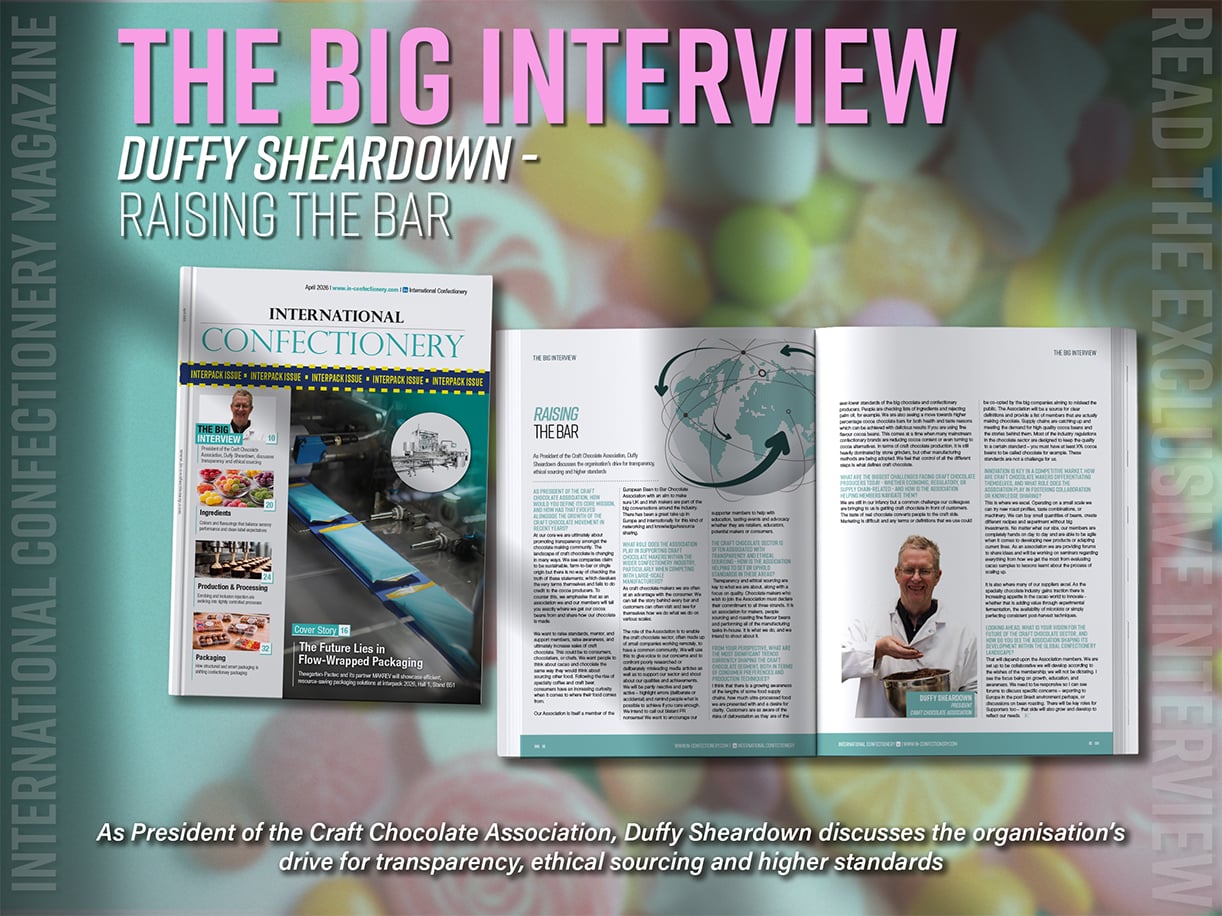

As President of the Craft Chocolate Association, Duffy Sheardown discusses the organisation’s drive for transparency, ethical sourcing and higher standards
As President of the Craft Chocolate Association, how would you define its core mission, and how has that evolved alongside the growth of the craft chocolate movement in recent years?
At our core we are ultimately about promoting transparency amongst the chocolate making community. The landscape of craft chocolate is changing in many ways. We see companies claim to be sustainable, farm-to-bar or single origin but there is no way of checking the truth of these statements, which devalues the very terms themselves and fails to do credit to the cocoa producers. To counter this, we emphasise that as an association we and our members will tell you exactly where we get our cocoa beans from and share how our chocolate is made.
We want to raise standards, mentor, and support members, raise awareness, and ultimately increase sales of craft chocolate. This could be to consumers, chocolatiers, or chefs. We want people to think about cacao and chocolate the same way they would think about sourcing other food. Following the rise of specialty coffee and craft beer, consumers have an increasing curiosity when it comes to where their food comes from.
Our Association is itself a member of the European Bean to Bar Chocolate Association with an aim to make sure UK and Irish makers are part of the big conversations around the industry. There has been a great take up in Europe and internationally for this kind of networking and knowledge/resource sharing.
What role does the Association play in supporting craft chocolate makers within the wider confectionery industry, particularly when competing with large-scale manufacturers?
As craft chocolate makers we are often at an advantage with the consumer. We can tell the story behind every bar and customers can often visit and see for themselves how we do what we do on various scales.
The role of the Association is to enable the craft chocolate sector, often made up of small companies working remotely, to have a common community. We will use this to give voice to our concerns and to confront poorly researched or deliberately misleading media articles as well as to support our sector and shout about our qualities and achievements. We will be partly reactive and partly active – highlight errors (deliberate or accidental) and remind people what is possible to achieve if you care enough. We intend to call out blatant PR nonsense! We want to encourage our supporter members to help with education, tasting events and advocacy whether they are retailers, educators, potential makers or consumers.
The craft chocolate sector is often associated with transparency and ethical sourcing – how is the Association helping to set or uphold standards in these areas?
Transparency and ethical sourcing are key to what we are about, along with a focus on quality. Chocolate makers who wish to join the Association must declare their commitment to all three strands. It is an association for makers, people sourcing and roasting fine flavour beans and performing all of the manufacturing tasks in-house. It is what we do, and we intend to shout about it.
From your perspective, what are the most significant trends currently shaping the craft chocolate segment, both in terms of consumer preferences and production techniques?
I think that there is a growing awareness of the lengths of some food supply chains, how much ultra-processed food we are presented with and a desire for clarity. Customers are as aware of the risks of deforestation as they are of the ever-lower standards of the big chocolate and confectionery producers. People are checking lists of ingredients and rejecting palm oil, for example. We are also seeing a move towards higher percentage cocoa chocolate bars for both health and taste reasons which can be achieved with delicious results if you are using fine flavour cocoa beans. This comes at a time when many mainstream confectionary brands are reducing cocoa content or even turning to cocoa alternatives. In terms of craft chocolate production, it is still heavily dominated by stone grinders, but other manufacturing methods are being adopted. We feel that control of all the different steps is what defines craft chocolate.
What are the biggest challenges facing craft chocolate producers today – whether economic, regulatory, or supply chain-related – and how is the Association helping members navigate them?
We are still in our infancy but a common challenge our colleagues are bringing to us is getting craft chocolate in front of customers. The taste of real chocolate converts people to the craft side. Marketing is difficult and any terms or definitions that we use could be co-opted by the big companies aiming to mislead the public. The Association will be a source for clear definitions and provide a list of members that are actually making chocolate. Supply chains are catching up and meeting the demand for high quality cocoa beans and the stories behind them. Most of the industry regulations in the chocolate sector are designed to keep the quality to a certain standard – you must have at least X% cocoa beans to be called chocolate for example. These standards are not a challenge for us.