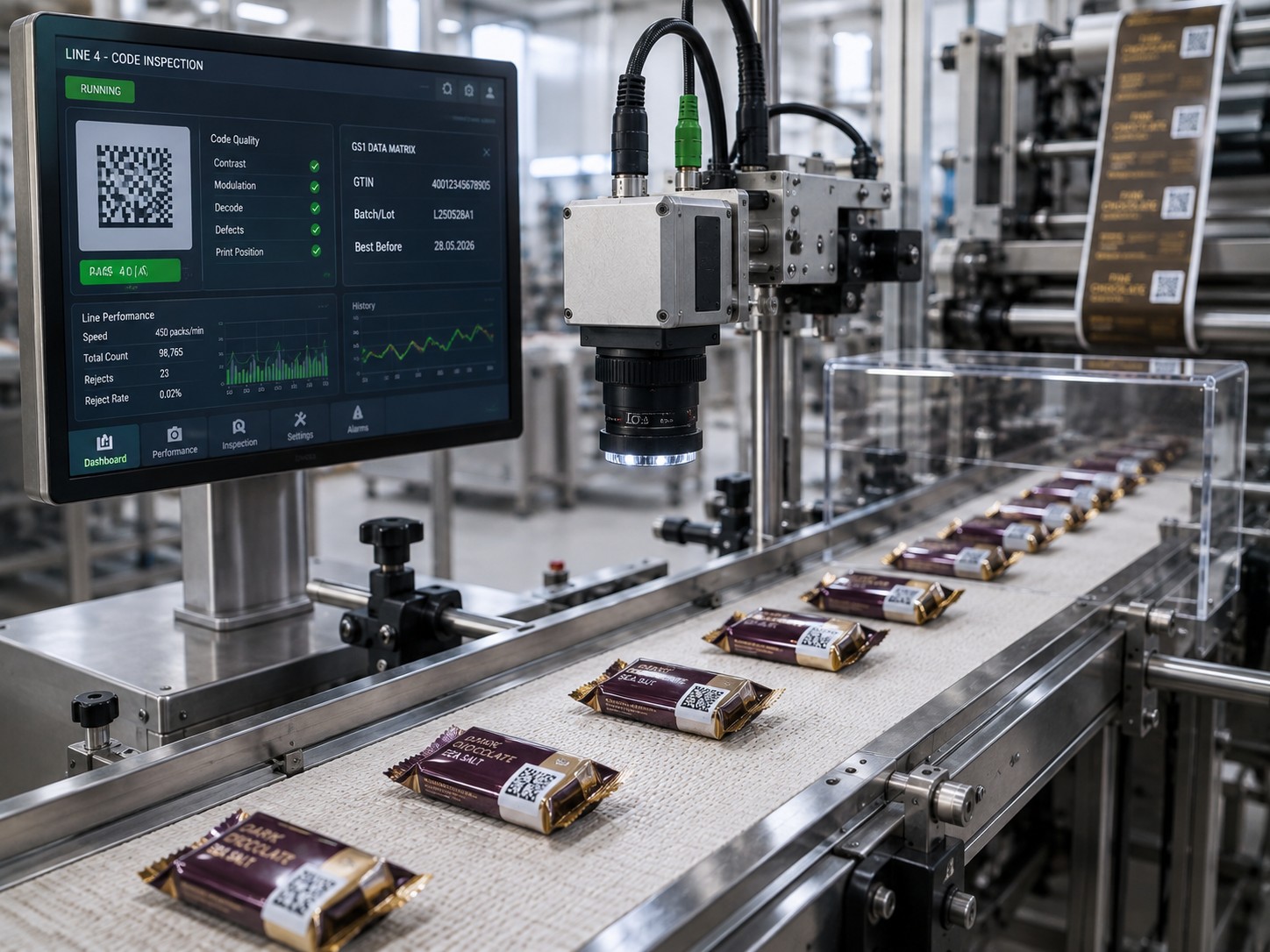

Assistant Editor Katie Tracy examines how PPWR, GS1 Sunrise 2027, smart labels and 2D QR coding are reshaping compliance across confectionery packaging lines.
Packaging has always performed several jobs simultaneously in confectionery. It protects products whose stability can depend on controlling moisture, oxygen, light and temperature exposure, provides the surface for mandatory food information and brand communication, and enables products to move through retail and distribution. What is changing is the amount of information the package is expected to carry or connect to, and how closely that information must integrate with manufacturing systems.
For confectionery producers, this shift coincides with significant regulatory and standards based change. The European Union’s Packaging and Packaging Waste Regulation, PPWR, is reshaping requirements around packaging design, recyclability, material use and information. In parallel, GS1’s transition towards greater use of two dimensional barcodes is preparing retail systems for data carriers capable of supporting more information than conventional linear barcodes. These developments are separate, and adopting a GS1 QR code does not itself create PPWR compliance. Their practical implications nevertheless intersect on the packaging line, where manufacturers must control materials, printed information and underlying product data while maintaining production speed and quality.
What does PPWR mean for confectionery packaging?
PPWR requires confectionery manufacturers to consider packaging design, material use, recyclability and information requirements as increasingly connected elements. This is significant because confectionery packaging rarely performs a purely decorative function. Chocolate bars, coated wafers, gummies, boiled sweets and filled products impose different barrier and mechanical requirements. Material reduction or substitution therefore has to be assessed against sealing performance, machinability, shelf life and product protection. A lighter structure that increases damaged products or compromises barrier performance simply transfers environmental and commercial costs elsewhere.
The information dimension adds another consideration. PPWR establishes harmonised labelling provisions and includes QR codes or other standardised, open digital data carriers for specified packaging information and applications. This does not mean legally required food information can simply migrate from the wrapper to a QR code. It does, however, illustrate a wider movement towards connecting physical packaging with digitally accessible information. For confectionery manufacturers operating across several markets, this is important because printable area is already under pressure from ingredients, allergens, nutritional information, mandatory particulars, branding and multilingual requirements.
Digital information can provide additional capacity, but only when the connection between the physical pack and digital information is dependable. A QR code that cannot be read consistently has little operational value. Substrate properties, print contrast, code positioning, material movement and inspection therefore become part of the information chain.
How will GS1 Sunrise 2027 affect confectionery manufacturers?
GS1 Sunrise 2027 means confectionery manufacturers need to prepare packaging and data systems for retail environments capable of processing GS1 conformant two dimensional barcodes alongside established linear barcodes. The end of 2027 represents an industry ambition for retail point of sale capability rather than a date on which conventional EAN and UPC barcodes suddenly disappear. GS1 anticipates coexistence while adoption develops across retailers, markets and product categories.
Read the full article here