
Managing Editor Rebecca Spayne reveals how slicing and multilayer assembly have become confectionery’s new battleground…
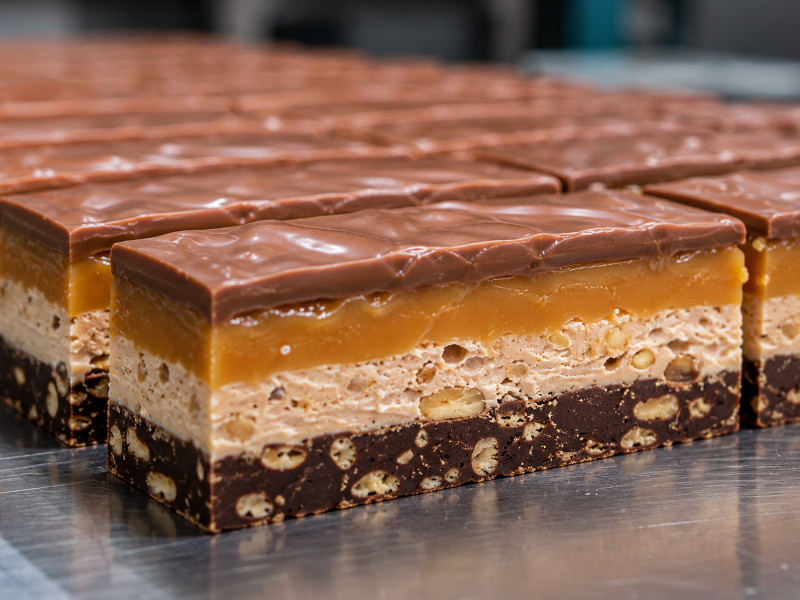
Confectionery has always been driven by innovation, but the nature of that innovation has changed considerably over the past decade. Where manufacturers once competed primarily through flavour development, seasonal launches and packaging design, today’s market increasingly rewards products that deliver a more sophisticated eating experience. Texture has become a critical differentiator. Consumers expect crunch alongside creaminess, softness alongside bite, and multiple flavour releases throughout a single consumption occasion. As a result, multilayer bars have become one of the industry’s most important formats.
The rise of these products reflects broader changes in consumer behaviour. Premiumisation continues to influence purchasing decisions across both chocolate and sugar confectionery, encouraging brands to create products that appear more indulgent and distinctive. At the same time, the growing overlap between confectionery, snacking and nutrition has introduced a new generation of products containing protein systems, functional ingredients and alternative formulations. Many of these products rely on layered structures to deliver their intended sensory experience, combining ingredients with very different physical characteristics within a single product.
What consumers see as innovation, however, manufacturers recognise as complexity. Every layer added to a product creates additional processing challenges. Different ingredients behave differently during production. They respond differently to temperature, pressure, moisture and handling. A caramel layer may require entirely different conditioning parameters than an aerated nougat. A protein-based centre may react differently to cooling than a traditional confectionery mass. Maintaining consistency across these varying components is one of the defining challenges facing modern confectionery production.
This shift has fundamentally altered the relationship between product development and manufacturing. Historically, production teams could often adapt existing processes to accommodate new products. Today, manufacturing considerations increasingly influence product design from the outset. Commercial success depends not only on whether a product can be developed, but whether it can be produced consistently and profitably at industrial scale. The most successful manufacturers are therefore becoming increasingly focused on how complexity can be controlled rather than simply how innovation can be achieved.
That reality has elevated the importance of production and processing technologies throughout the sector. Yet the conversation is no longer centred solely on throughput. Manufacturers continue to value efficiency, but there is growing recognition that consistency, flexibility and process stability are equally important. A production line capable of producing large volumes offers limited value if it cannot maintain quality across increasingly sophisticated product formats. The focus has therefore shifted towards understanding how every stage of production contributes to the performance of the final product.
Managing Variation Before It Becomes a Problem
One of the most significant developments in confectionery manufacturing is the growing appreciation of how early-stage processes influence downstream performance. In multilayer bar production, success is rarely determined by a single piece of equipment. Instead, it is shaped by the cumulative effect of numerous decisions made throughout the production line.
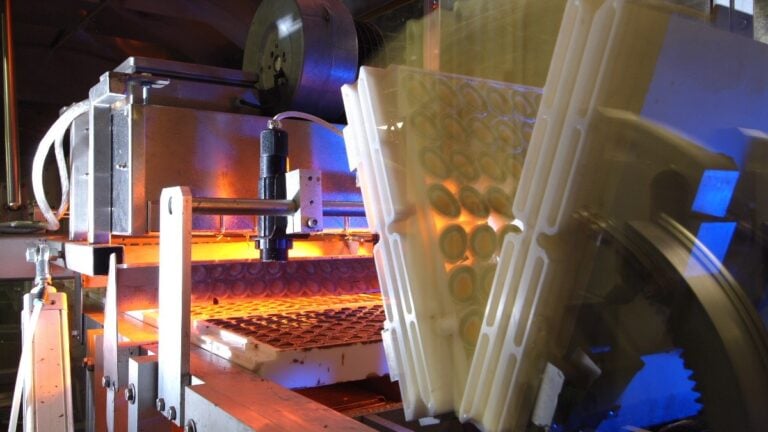
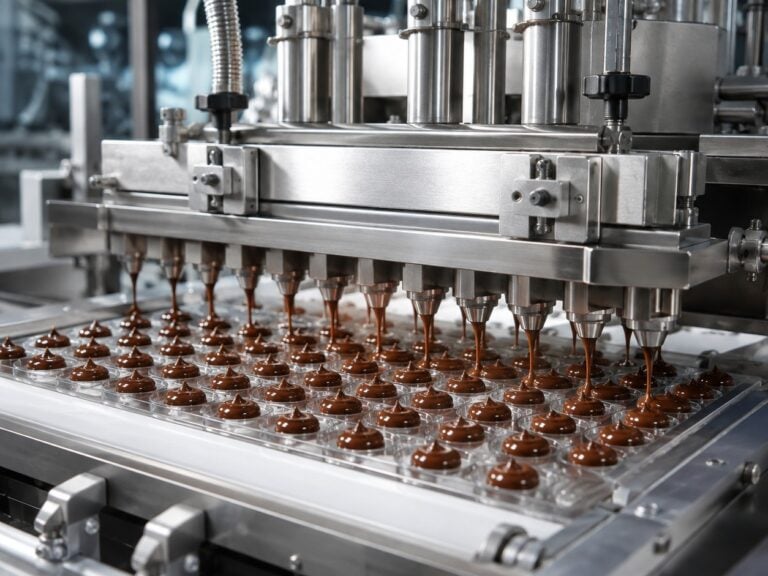
The formation of a multilayer product begins long before slicing takes place. Depositing, layering and slab construction establish the structural foundation upon which the entire process depends. If layers are applied inconsistently, if ingredient distribution varies or if dimensional accuracy is compromised, those issues are unlikely to disappear further down the line. More often, they become amplified.
This is particularly important as manufacturers pursue increasingly sophisticated product architectures. Layered products must retain their intended structure while moving through multiple stages of processing. Ingredients with different viscosities and physical properties must work together within a single product format. Small inconsistencies that might once have been tolerated can now affect everything from appearance and weight control to packaging performance and shelf stability.
Suppliers operating within depositing and product forming technologies have responded accordingly. Companies such as Tanis have become increasingly relevant in applications where precision and repeatability are essential to maintaining complex product structures. The industry’s growing appetite for layered products, deposited centres and hybrid confectionery formats has created demand for production systems capable of delivering greater control without sacrificing flexibility. As manufacturers diversify their portfolios, the ability to switch between product types while maintaining consistency has become a significant competitive advantage.
However, forming the product is only one part of the equation. Once layers have been created, they must be stabilised. This is where process control becomes increasingly important. Cooling and conditioning remain among the most influential yet frequently underestimated stages within multilayer bar manufacture. Consumers rarely consider the role temperature management plays in product quality, but manufacturers understand that thermal control influences almost every aspect of downstream performance.
Cooling affects texture, structural integrity and dimensional stability. More importantly, it influences how products behave during cutting. A layer that remains too soft may deform under pressure. A layer that becomes too brittle may fracture. When multiple textures exist within a single product, balancing these variables becomes significantly more challenging. Manufacturers must therefore create conditions that support the performance of the entire product rather than individual components.
This emphasis on process stability has brought renewed attention to continuous cooling and conditioning technologies. Companies such as IPCO increasingly operate at the intersection of product quality and process control, providing systems designed to support consistency across increasingly demanding applications. As product complexity continues to rise, cooling is being viewed less as a supporting utility and more as an integral part of quality management.