
Baker Perkins recently shared insights around the scaling of pectin and gelatin in industrial production…
With growth of the gummy market on an ever increasing trajectory, you may be looking into the nuances of pectin vs gelatin in industrial production to help you choose the best option. While both ingredients can create high-quality products, how they behave at scale creates very different challenges, and knowing the differences can support a smoother production and higher quality result.
Understanding pectin vs gelatin scaling issues is critical when optimising the gummy manufacturing process, particularly when working with modern confectionery production lines and depositor systems.
What’s the Difference Between Pectin and Gelatin?
At a formulation level, gelatin and pectin create very different textures and require specific processing conditions.
- Gelatin delivers a classic chewy, elastic texture and sets through cooling
- Pectin is typically used in plant-based recipes and forms a gel through a combination of sugar concentration, pH level, and temperature control
These differences may seem straightforward at a small scale, but significant complexity is introduced when scaling confectionery depositing systems.
What Are the Considerations for Gelatin in Large-Scale Use?
Gelatin has long been the gelling agent of choice for gummy production due to its forgiving nature during manufacturing. However, it comes with challenges at an industrial scale that you may find difficult to manage.
Key Scaling Considerations
- Temperature Control
Gelatin has to stay within quite a tight temperature range to maintain flow properties. Make it too hot, and the structure weakens; too cool, and viscosity increases, which can affect accuracy. - Viscosity Stability
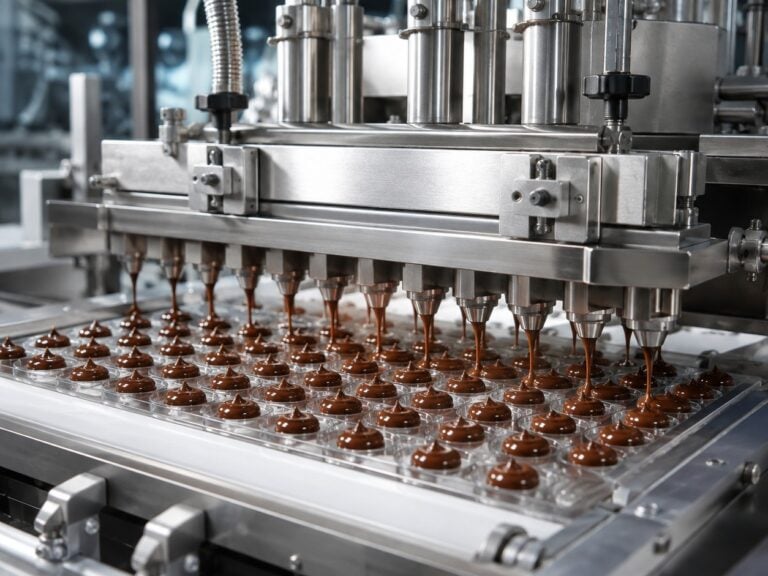
Consistent thickness is essential for precise product creation in a gummy depositor. Variations can lead to weight discrepancies, and impact product quality and compliance, particularly in regulated markets. - Longer Setting Time
Gelatin requires cooling to set, which can extend production cycles. Despite these factors, gelatin remains relatively stable during high-speed depositing. This makes it well-suited to large scale confectionery depositors when process conditions are well controlled.
What Are the Considerations for Pectin in Large-Scale Use?
Pectin offers clear advantages for plant-based and clean-label products, but introduces more demanding process requirements when scaling.
Key Scaling Considerations
- Precise Acidification
Pectin relies on pH to set, making acid addition techniques for consistent pectin setting at scale important. The problem with this is, poor control can result in premature setting or incomplete gel formation. - Narrow Process Window
Unlike gelatin, pectin has a much tighter operating window to get it right. Small deviations in temperature or pH can significantly affect product quality. - Rapid Setting
Pectin begins to set quickly once deposited, which can be advantageous, but only if the depositing system is well optimised. Otherwise, it can lead to blockages or inconsistent fill.