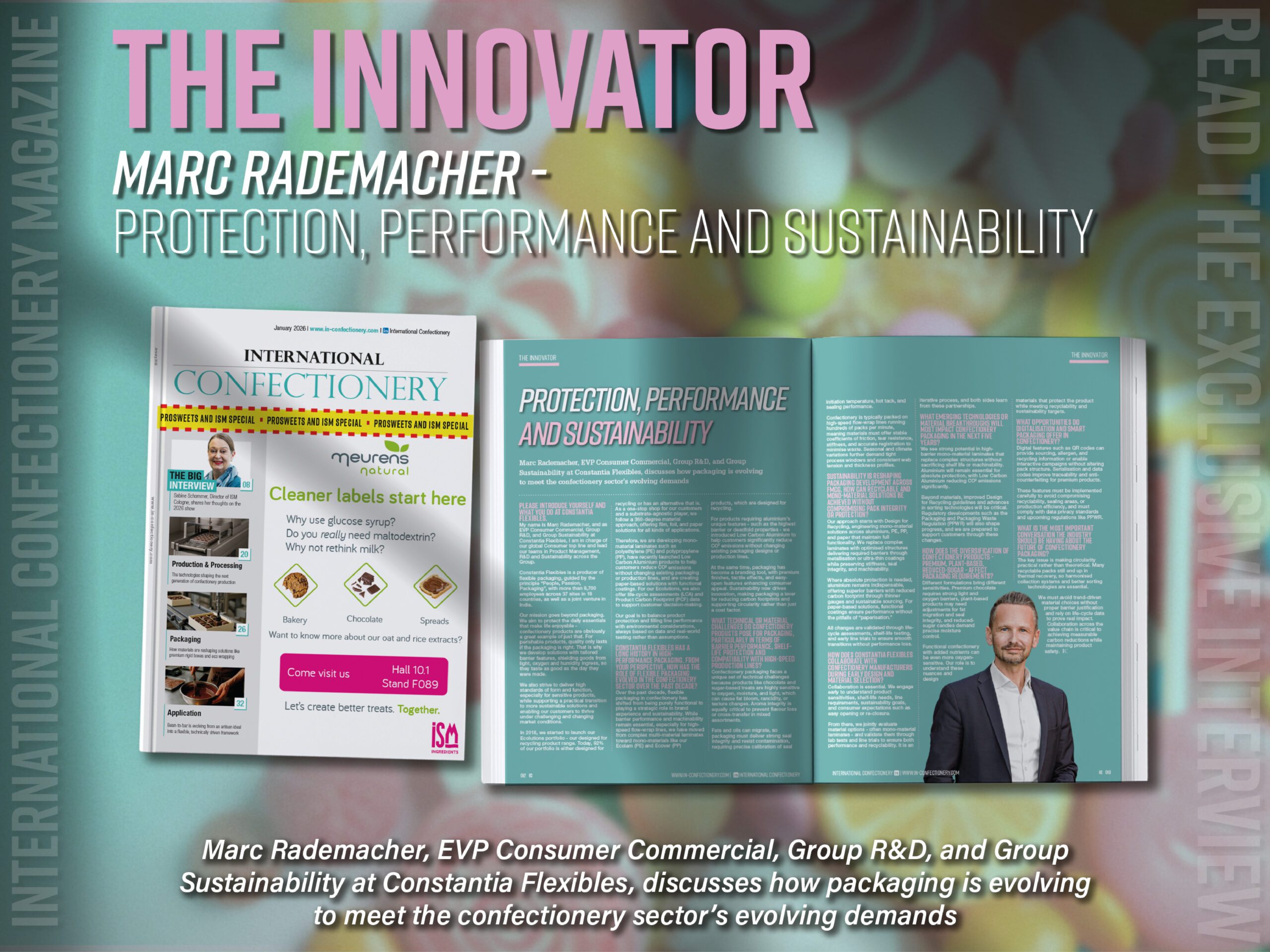

Marc Rademacher, EVP Consumer Commercial, Group R&D, and Group Sustainability at Constantia Flexibles, discusses how packaging is evolving to meet the confectionery sector’s evolving demands
Please introduce yourself and what you do at Constantia Flexibles.
My name is Marc Rademacher, and as EVP Consumer Commercial, Group R&D, and Group Sustainability at Constantia Flexibles, I am in charge of our global Consumer top line and lead our teams in Product Management, R&D and Sustainability across the Group.
Constantia Flexibles is a producer of flexible packaging, guided by the principle “People, Passion, Packaging”, with more than 8,700 employees across 37 sites in 18 countries, as well as a joint venture in India.
Our mission goes beyond packaging. We aim to protect the daily essentials that make life enjoyable – confectionery products are obviously a great example of just that. For perishable products, quality only lasts if the packaging is right. That is why we develop solutions with tailored barrier features, shielding goods from light, oxygen and humidity ingress, so they taste as good as the day they were made.
We also strive to deliver high standards of form and function, especially for sensitive products, while supporting a practical transition to more sustainable solutions and enabling our customers to thrive under challenging and changing market conditions.
In 2018, we started to launch our Ecolutions portfolio – our designed for recycling product range. Today, 92% of our portfolio is either designed for recycling or has an alternative that is. As a one-stop shop for our customers and a substrate-agnostic player, we follow a 360-degree material approach, offering film, foil, and paper solutions for all kinds of applications.
Therefore, we are developing mono-material laminates such as polyethylene (PE) and polypropylene (PP), have recently launched Low Carbon Aluminium products to help customers reduce CO₂ emissions without changing existing packaging or production lines, and are creating paper-based solutions with functional coatings. For our Ecolutions, we also offer life-cycle assessments (LCA) and Product Carbon Footprint (PCF) data to support customer decision-making.
Our goal is to balance product protection and filling line performance with environmental considerations, always based on data and real-world testing rather than assumptions.
Constantia Flexibles has a long history in high-performance packaging. From your perspective, how has the role of flexible packaging evolved in the confectionery sector over the past decade?
Over the past decade, flexible packaging in confectionery has shifted from being purely functional to playing a strategic role in brand experience and sustainability. While barrier performance and machinability remain essential, especially for high-speed flow-wrap lines, we have moved from complex multi-material laminates toward mono-materials like our Ecolam (PE) and Ecover (PP) products, which are designed for recycling.
For products requiring aluminium’s unique features – such as the highest barrier or deadfold properties – we introduced Low Carbon Aluminium to help customers significantly reduce CO₂ emissions without changing existing packaging designs or production lines.
At the same time, packaging has become a branding tool, with premium finishes, tactile effects, and easy-open features enhancing consumer appeal. Sustainability now drives innovation, making packaging a lever for reducing carbon footprints and supporting circularity rather than just a cost factor.
What technical or material challenges do confectionery products pose for packaging, particularly in terms of barrier performance, shelf-life protection and compatibility with high-speed production lines?
Confectionery packaging faces a unique set of technical challenges because products like chocolate and sugar-based treats are highly sensitive to oxygen, moisture, and light, which can cause fat bloom, rancidity, or texture changes. Aroma integrity is equally critical to prevent flavour loss or cross-transfer in mixed assortments.
Fats and oils can migrate, so packaging must deliver strong seal integrity and resist contamination, requiring precise calibration of seal initiation temperature, hot tack, and sealing performance.
Confectionery is typically packed on high-speed flow-wrap lines running hundreds of packs per minute, meaning materials must offer stable coefficients of friction, tear resistance, stiffness, and accurate registration to minimise waste. Seasonal and climate variations further demand tight process windows and consistent web tension and thickness profiles.
Read the full interview in our latest issue here