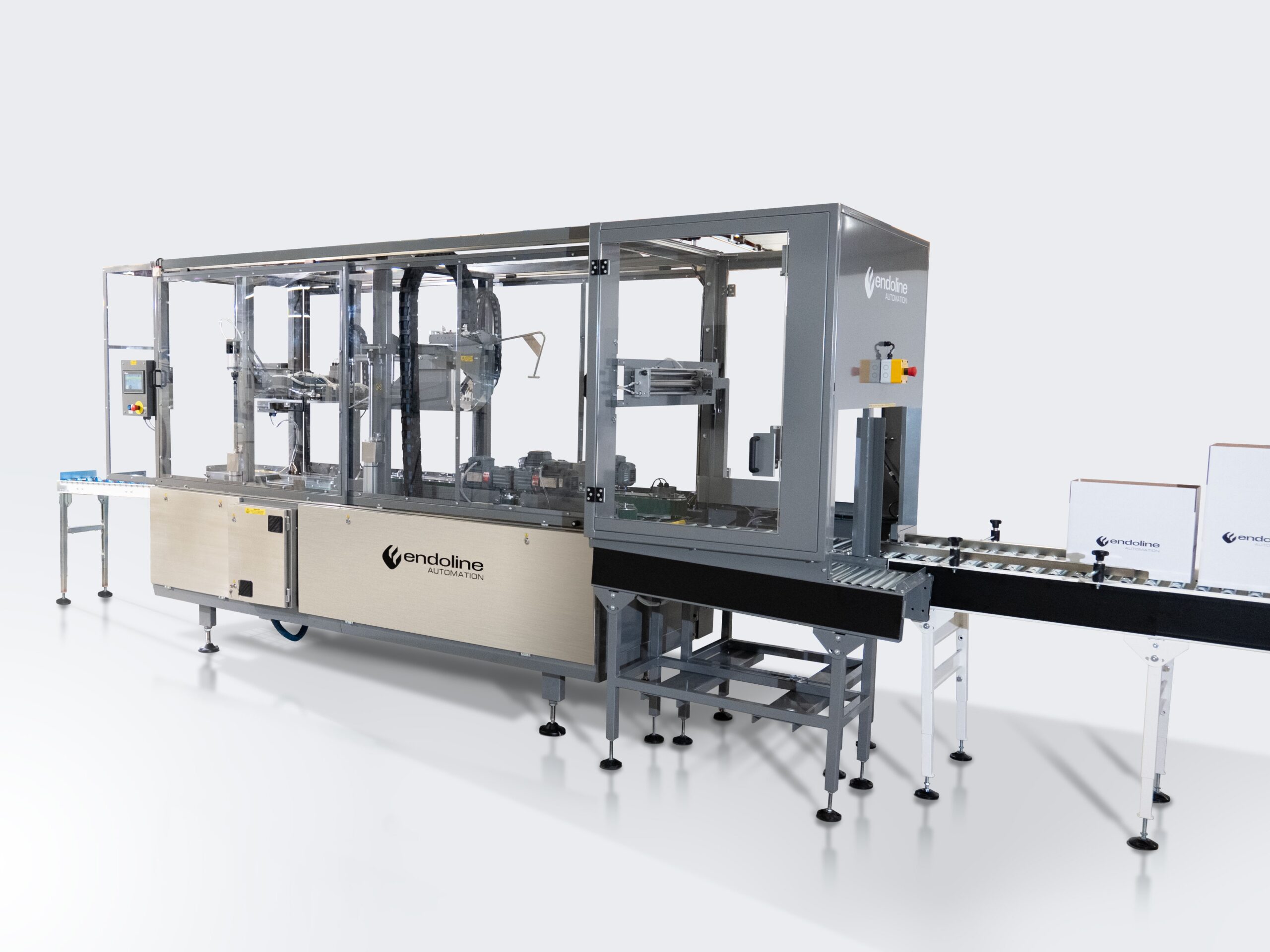

Providing additional case strength, increased line speed and reduced consumable costs, Endoline has developed a solution that met a confectionery brand’s demanding requirements for handling heavy, pre-loaded chewing gum cases.
Faster, More Flexible Case Sealing
The award-winning 407 High-Speed Random Case Gluer from Endoline was designed to handle varying cardboard case sizes entering the machine in succession. For manufacturers supplying multiple retailers, particularly confectionery producers, this flexibility can significantly improve production line efficiency.
The first-of-its-kind machine can process 16–18 randomly sized cases per minute. It automatically adjusts its settings to hot-glue boxes of varying heights, widths and depths at both the top and bottom, regardless of the sequence in which they enter the machine.
For greater flexibility, the 407 can accommodate case sizes ranging from 300–560mm in length, 170–350mm in width and 210–360mm in height.
“This increased efficiency is due to the inclusion of servo drives, rather than cam drives, which allows greater acceleration and deceleration of the moving heads and side drives during the sealing process,” explains Andrew Yates, Managing Director at Endoline Automation.
“With the added support of sensors and barcode scanners, plus an infeed conveyor that centralises each case with guides to feed into the machine, the 407 can significantly increase manufacturers’ packing throughput and reduce labour costs, helping optimise downstream supply chain operations.”
Making a Case for Sustainability
Many high-speed packaging lines must seal numerous case sizes in succession. At the same time, manufacturers are increasingly seeking more secure and sustainable tamper-evident sealing methods, including hot glue.
“Choosing glue packaging over tape isn’t just about precision; it’s about trust. While glue machines may operate at a slightly slower pace, the tamper-evident seal they create offers customers an added layer of security and confidence in their product integrity,” says Yates.
Once set, a glue seal is extremely difficult to remove without damaging the case, whereas tape can often be reapplied. This can increase the risk of tampering, customer complaints and returns.
For Endoline’s customer, the strength of glue adhesion was an important consideration.
“Compared to tape, glue adhesion is much better suited to heavy cases, such as confectionery, bottles, eggs and jars,” explains James Ramsey, Export Sales Manager at Endoline Automation, who oversaw installation at the customer’s Australian facility. “Tape tends to either unstick in the heat or go brittle in the cold. Glue is a lot more durable in all weather conditions.”
Glue also supported the confectionery manufacturer’s sustainability and net-zero objectives. By eliminating packaging tape, the company can improve the recyclability of its cardboard cases and reduce the amount of additional packaging material entering the waste stream.
There are potential operational savings too. Industry estimates suggest glue granules can cost up to three times less than tape per case over the long term. Glue tanks can also generally be refilled while machinery remains operational, avoiding the downtime associated with replacing tape rolls.
To support uptime, the 407 features a full sensor kit that alerts operators when glue levels are running low. HMI messaging provides visual or audible warnings, helping operators intervene before production is disrupted.
By combining higher throughput, secure case sealing, lower consumable usage and improved recyclability, Endoline’s solution is enabling the confectionery manufacturer to strengthen both its packaging performance and sustainability credentials.