Theegarten-Pactec and its partner MAKREV will showcase efficient, resource-saving packaging solutions at interpack 2026, Hall 1, Stand B51
While Theegarten-Pactec is known for high-speed solutions for packaging small confectionery items in combination with a multitude of folding types, the company will be placing a particular focus on effective packaging in flow packs at interpack 2026. Both new as well as evolved, proven systems will be on display. Manufacturers of chocolate, bars, snacks and functional foods will experience how they can benefit from maximum flexibility, automated lines and digitally networked machines from this innovation driver – customised, smart solutions for a wide variety of products, packaging materials and performance ranges.
FPC6: from the flow pack directly into the carton
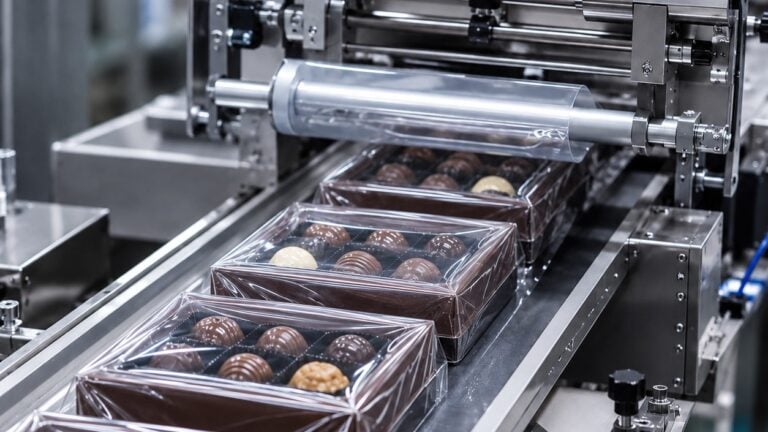
With the FPC6, a new generation of machines which will be presented at interpack for the first time, Theegarten-Pactec is deliberately focusing not on ‘faster, higher, further’, but on stable efficiency. The high-performance machine reliably packs chocolate bars, tablets and pralines into flow packs and is specifically aimed at manufacturers of chocolate, confectionery, muesli and protein bars, functional foods and snacks, as well as co-packers and contract packers. With the new machine, Theegarten-Pactec is also providing a single-source system that feeds flow-wrapped bars directly into the BLM cartoner.
The FPC6 has been engineered for maximum user-friendliness: mechanical enhancements reduce complexity and, given the ongoing shortage of skilled workers, also support less experienced personnel in safe and reliable operation. An improved display also simplifies troubleshooting: the machine alerts the operator to the location of the possible problem area. This allows the machine to be operated independently with high efficiency. The tool-free removal of machine parts also contributes to this: critical parts that are prone to contamination can be replaced without tools. They are designed in line with the ‘poka-yoke’ principle (a Japanese method for preventing errors in production and work processes), i.e. installation errors are prevented from the outset because the components are designed in such a way that incorrect installation during format changes and/or cleaning is impossible. These include, for example, belt assemblies and belt guides.
Flexibility in sealing – whether longitudinal or transverse
The FPC6’s sealing device has also been designed to reduce complexity. It is exceptionally user-friendly and enables fast, reliable and error-free format changes. The tool-free replacement of the cross-sealing unit is guided and largely automatic via the HMI (Human-Machine Interface) and can be carried out with a conventional manual pallet truck – special, and often expensive, transport devices are not required. Furthermore, the machine not only processes a wide variety of product formats without major changeover effort, but can also master several types of sealing – cold sealing, heat sealing and separation seam welding for water-soluble films – thereby offering maximum flexibility in terms of packaging materials. An integrated preheating section ensures that even sensitive materials such as paper or recyclable mono films can be processed reliably and with the highest possible efficiency and consistent quality. The sealing pressure of the longitudinal sealing unit can be conveniently adjusted electronically via the HMI. Additionally, a new coupling system in the drive of the transverse sealing unit increases component longevity. Manual readjustment of the gears is no longer necessary, which significantly reduces wear. Adjusting the cross seal to different films is now also much easier. The seal gap can be adjusted in a fully reproducible manner, always ensuring consistent sealing results. Time-consuming, repeated readjustments during format changes are now a thing of the past.
‘Flying Splice’ high-efficiency changes, reliable processes with web edge control
On average, the packaging material needs to be changed every 20 to 30 minutes during the packaging process, which is why the FPC6’s packaging material unwinding system has also been optimised. In conjunction with the sealing device, the ‘Flying Splice’ takes over critical steps that previously required precise threading and gluing of the double-sided adhesive strip. A roll prepared with adhesive tape is simply placed on the machine; no further steps or special precautions are necessary. Correct application, alignment and feeding are all performed automatically. Furthermore, roll changes can be carried out without reducing speed, even at packaging speeds of 150 m/min. The ‘Flying Splice’ feature increases both process reliability and system availability with minimal training requirements.
The FPC6’s packaging material web tracking control also allows the course of the film web to be adjusted directly on the HMI – for example, depending on the batch or when changing flavours. Old and new values are automatically stored in the recipe management system. Manual settings that were previously necessary are no longer required, and the original target value is retained.