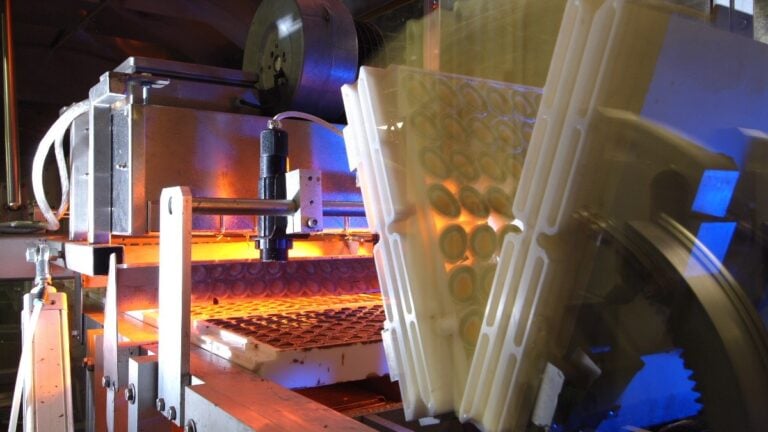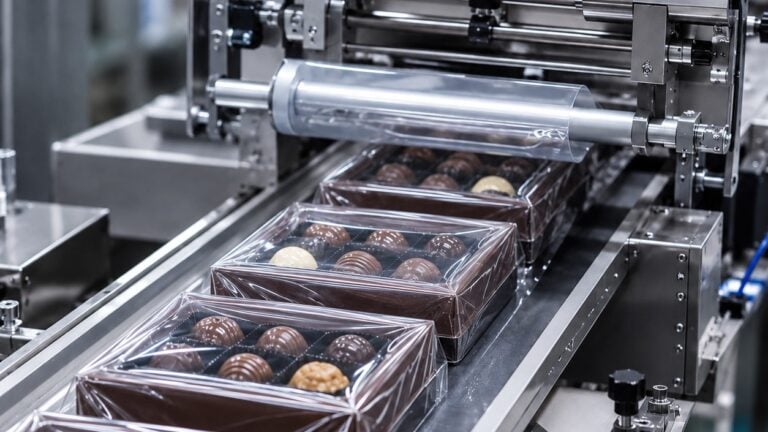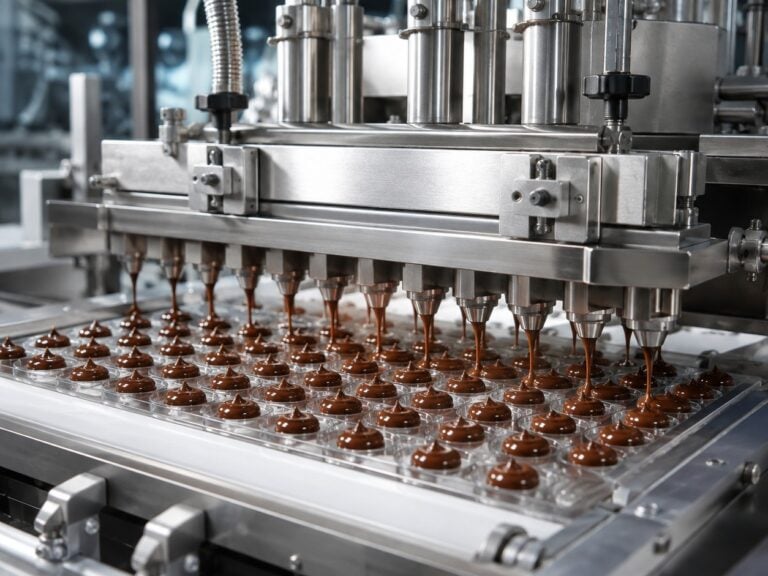

Enrobing and inclusion injection occupy a decisive position at the point where formulation, mechanical handling, and thermal control converge. Although often categorised as finishing operations, both processes directly determine final product structure, weight distribution, and surface integrity. In practical terms, they are less about decoration and more about defining how a confectionery product holds together under production, storage, and transport conditions.
The engineering challenge lies in synchronising multiple variables that do not naturally align. Coating systems must maintain stable flow behaviour while operating within narrow temperature tolerances required for correct fat crystallisation. At the same time, injection systems must deliver precise volumes of fillings with varying rheological properties, often containing particulates, without disrupting shell formation or causing deformation during downstream handling. These interactions are not isolated. A minor shift in viscosity or temperature upstream can translate into coating inconsistency, centre displacement, or cooling inefficiencies further along the line.
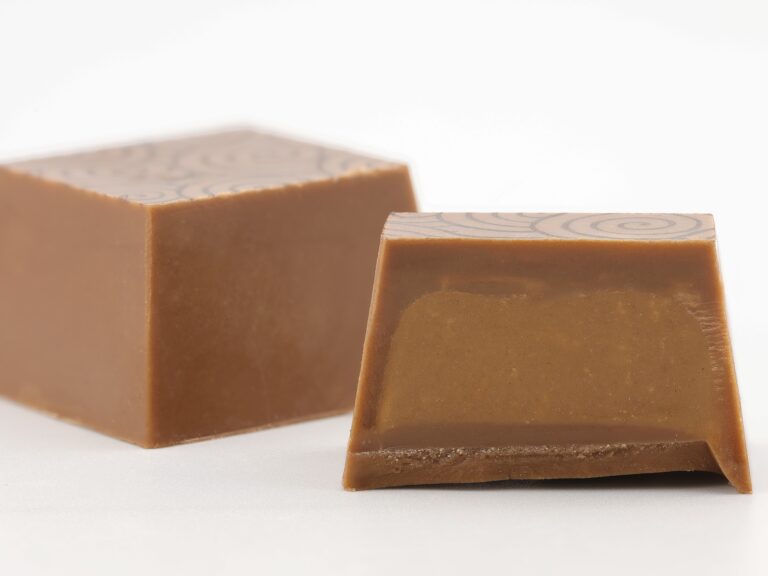
This complexity has intensified as product formats have evolved. Multi-layer bars, filled pralines, and inclusion-rich applications introduce competing requirements: higher throughput, tighter weight control, and increasingly intricate internal structures. The margin for manual adjustment has narrowed accordingly. Where operators once compensated for variability through experience, modern lines require repeatable, system-level precision across coating thickness, injection accuracy, and thermal stability.
The growing importance of coating performance is also reflected in how enrobing contributes to final product perception. As Philippe Bernay, Indulgence Commercial Marketing Director at Cargill, explains: “Gloss, snap, melt, contrast and flavour release all influence how indulgent a confection feels. Through coatings and enrobing, manufacturers can create layered sensory experiences, combining crunch and creaminess, sweetness balance and visual appeal in ways that elevate everyday formats.”
As a result, enrobing and inclusion injection are now being approached as integrated process disciplines rather than discrete unit operations. Equipment design and line configuration increasingly reflect this shift, with manufacturers developing systems capable of maintaining consistent flow conditions and synchronised operation across high-speed environments, as seen in industrial enrobing and depositing technologies from suppliers such as Sollich, Aasted, and Tanis.
Flow, Viscosity, and Structural Integrity
At the core of both enrobing and inclusion injection lies the behaviour of materials under movement. Chocolate, compound coatings, and filled centres are not static substances; they respond continuously to shear, temperature, and pressure. Maintaining control over that behaviour is fundamental to achieving consistency at scale.
In enrobing, coating uniformity is governed by the stability of the chocolate curtain and the interaction between flow rate and viscosity. Even small deviations in temperature can alter viscosity sufficiently to affect curtain thickness, leading to uneven coating weights or exposed product surfaces. The relationship is tightly coupled: higher viscosity improves coverage but risks excessive build-up, while lower viscosity increases flow but can reduce adhesion and create thin spots. Mechanical elements such as bottoming rollers and vibration systems are therefore not secondary features, but essential tools for redistributing coating mass and correcting flow irregularities in real time.