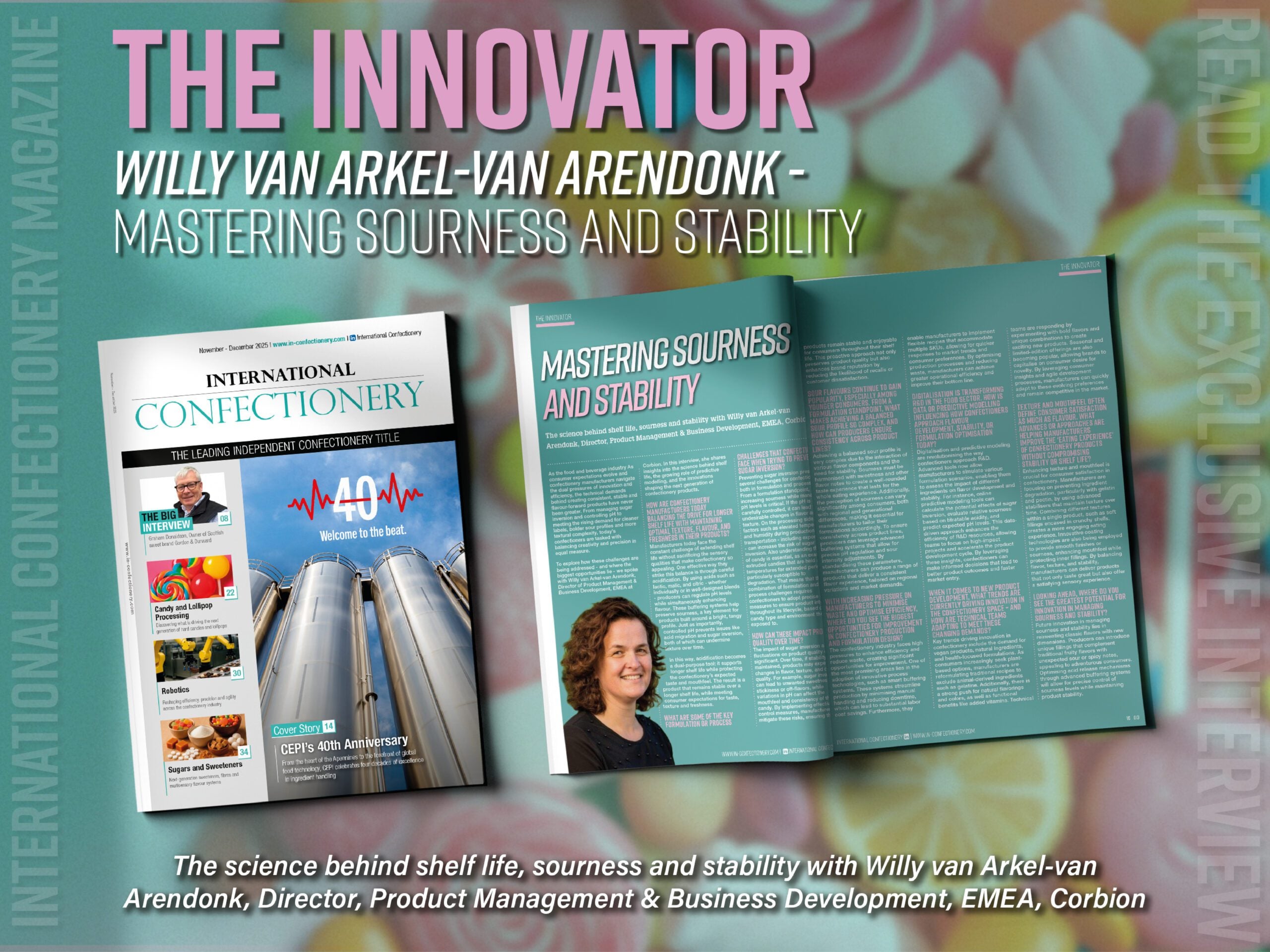

The science behind shelf life, sourness and stability with Willy van Arkel-van Arendonk, Director, Product Management & Business Development, EMEA, Corbion
As consumer expectations evolve and confectionery manufacturers navigate the dual pressures of innovation and efficiency, the technical demands behind creating consistent, stable and flavour-forward products have never been greater. From managing sugar inversion and controlling pH to meeting the rising demand for cleaner labels, bolder sour profiles and more textural complexity, today’s confectioners are tasked with balancing creativity and precision in equal measure.
To explore how these challenges are being addressed – and where the biggest opportunities lie – we spoke with Willy van Arkel-van Arendonk, Director of Product Management & Business Development, EMEA at Corbion. In this interview, she shares insights into the science behind shelf life, the growing role of predictive modelling, and the innovations shaping the next generation of confectionery products.
How are confectionery manufacturers today balancing the drive for longer shelf life with maintaining optimal texture, flavour, and freshness in their products?
Manufacturers today face the constant challenge of extending shelf life without sacrificing the sensory qualities that make confectionery so appealing. One effective way they strike this balance is through careful acidification. By using acids such as lactic, malic, and citric – whether individually or in well-designed blends – producers can regulate pH levels while simultaneously enhancing flavour. These buffering systems help preserve sourness, a key element for products built around a bright, tangy profile. Just as importantly, controlled pH prevents issues like acid migration and sugar inversion, both of which can undermine texture over time.
In this way, acidification becomes a dual-purpose tool: it supports longer shelf life while protecting the confectionery’s expected taste and mouthfeel. The result is a product that remains stable over a longer shelf life, while meeting consumer expectations for taste, texture and freshness.
What are some of the key formulation or process challenges that confectioners face when trying to prevent sugar inversion?
Preventing sugar inversion presents several challenges for confectioners, both in formulation and processing. From a formulation standpoint, increasing sourness while managing pH levels is critical. If the pH is not carefully controlled, it can lead to undesirable changes in flavour and texture. On the processing side, factors such as elevated temperatures and humidity during production and transportation – including exportation – can increase the risk of sugar inversion. Also understanding the type of candy is essential, as an example, extruded candies that are held at high temperatures for extended periods are particularly susceptible to degradation. That means that this combination of formulation and process challenges requires confectioners to adopt precise control measures to ensure product integrity throughout its lifecycle, based on the candy type and environment they are exposed to.
How can these impact product quality over time?
The impact of sugar inversion and pH fluctuations on product quality can be significant. Over time, if stability is not maintained, products may experience changes in flavor, texture, and overall quality. For example, sugar inversion can lead to unwanted sweetness, stickiness or off-flavours, while variations in pH can affect the mouthfeel and consistency of the candy. By implementing effective pH control measures, manufacturers can mitigate these risks, ensuring that products remain stable and enjoyable for consumers throughout their shelf life. This proactive approach not only preserves product quality but also enhances brand reputation by reducing the likelihood of recalls or customer dissatisfaction.
Sour flavours continue to gain popularity, especially among younger consumers. From a formulation standpoint, what makes achieving a balanced sour profile so complex, and how can producers ensure consistency across product lines?
Achieving a balanced sour profile is very complex due to the interaction of various flavour components and the need for stability. Sourness must be harmonised with sweetness and other flavor notes to create a well-rounded taste experience that lasts for the whole eating experience. Additionally, the perception of sourness can vary significantly among consumers, both with regional and generational differences, making it essential for manufacturers to tailor their formulations accordingly. To ensure consistency across product lines, producers can leverage advanced buffering systems that allow for precise pH regulation and sour intensity adjustments. By standardising these parameters, manufacturers can produce a range of products that deliver a consistent flavour experience, tailored on regional variations and market demands.
Read more latest industry news and developments in our free to download magazine.
Never miss a story… Follow us on:
LinkedIn: International Confectionery
YouTube: @ConfectioneryTV
Media contact
Joseph Clarke
Editor, International Confectionery
Tel: +44 (0) 1622 823 920
Email: [email protected]