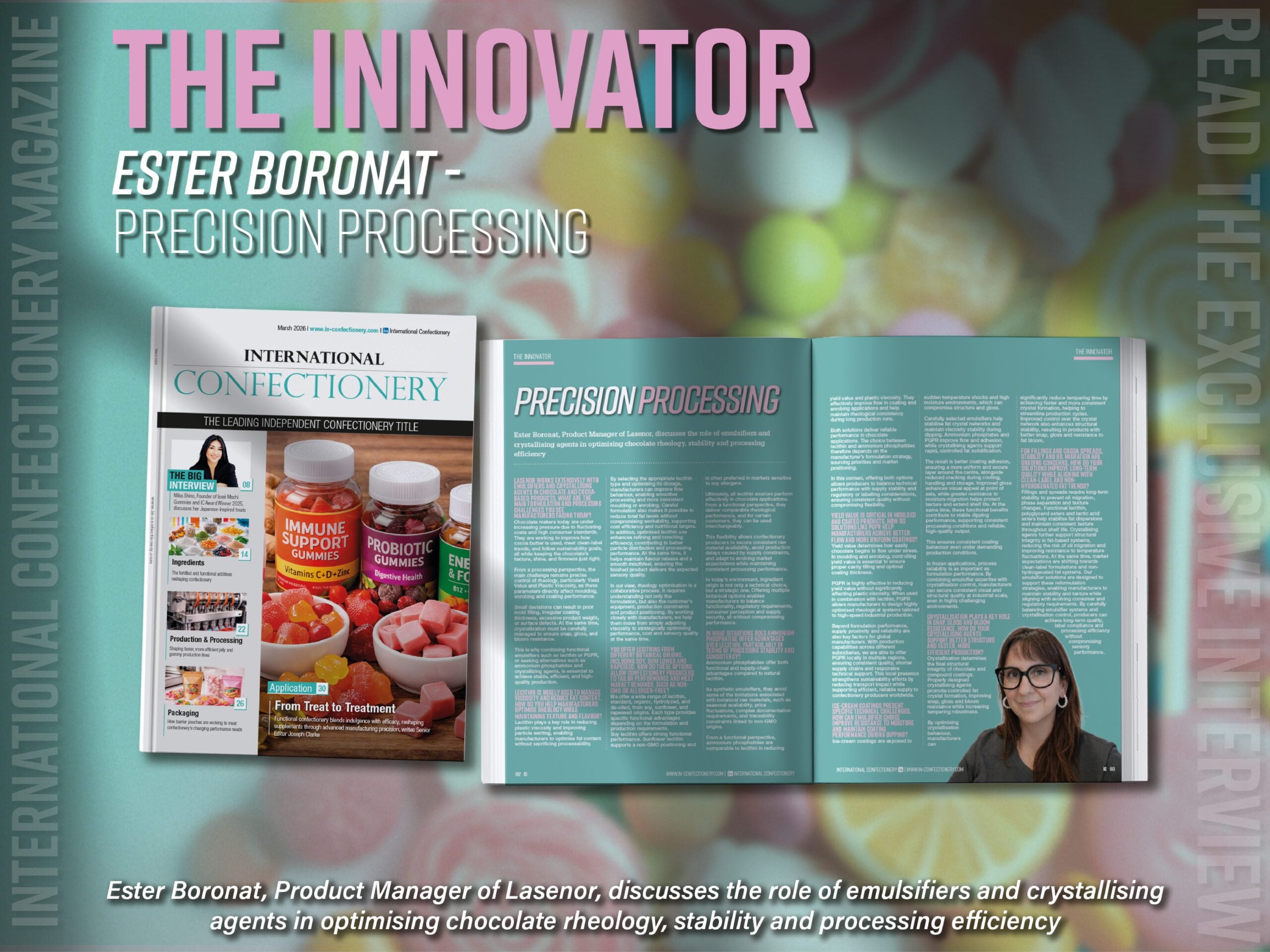

Ester Boronat, Product Manager of Lasenor, discusses the role of emulsifiers and crystallising agents in optimising chocolate rheology, stability and processing efficiency
Lasenor works extensively with emulsifiers and crystallising agents in chocolate and cocoa-based products. What are the main formulation and processing challenges you see manufacturers facing today?
Chocolate makers today are under increasing pressure due to fluctuating costs and high consumer standards. They are working to improve how cocoa butter is used, meet clean-label trends, and follow sustainability goals, all while keeping the chocolate’s texture, shine, and firmness just right.
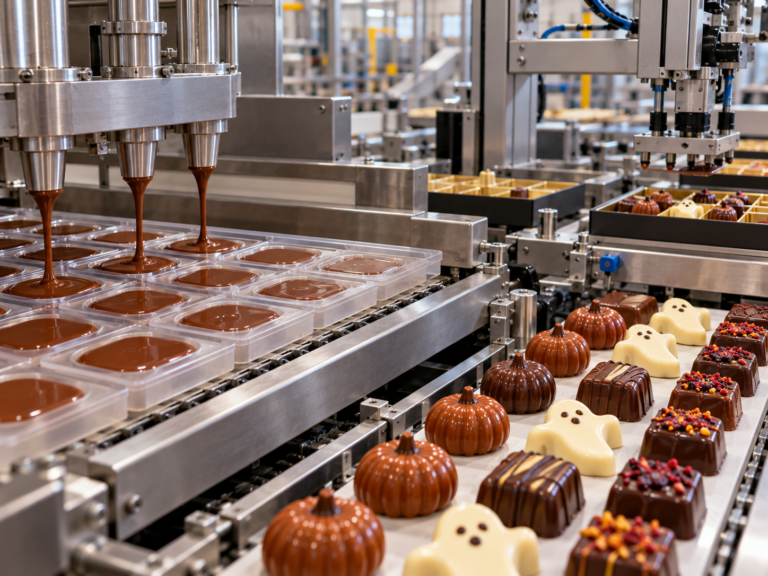
From a processing perspective, the main challenge remains precise control of rheology, particularly Yield Value and Plastic Viscosity, as these parameters directly affect moulding, enrobing and coating performance.
Small deviations can result in poor mold filling, irregular coating thickness, excessive product weight, or surface defects. At the same time, crystallization must be carefully managed to ensure snap, gloss, and bloom resistance.
This is why combining functional emulsifiers such as lecithin or PGPR, or seeking alternatives such as ammonium phosphatides and crystallizing agents, is essential to achieve stable, efficient, and high-quality production.
Lecithin is widely used to manage viscosity and reduce fat content. How do you help manufacturers optimise rheology while maintaining texture and flavour?
Lecithin plays a key role in reducing plastic viscosity and improving particle wetting, enabling manufacturers to optimise fat content without sacrificing processability.
By selecting the appropriate lecithin type and optimising its dosage, manufacturers can improve flow behaviour, enabling smoother processing and more consistent moulding or enrobing. Careful formulation also makes it possible to reduce total fat levels without compromising workability, supporting cost efficiency and nutritional targets. In addition, optimised lecithin use enhances refining and conching efficiency, contributing to better particle distribution and processing performance. At the same time, it helps maintain flavour release and a smooth mouthfeel, ensuring the finished product delivers the expected sensory quality.
In our view, rheology optimisation is a collaborative process. It requires understanding not only the formulation, but also the customer’s equipment, production constraints and product positioning. By working closely with manufacturers, we help them move from simply adjusting viscosity to strategically optimising performance, cost and sensory quality at the same time.
You offer lecithins from different botanical origins, including soy, sunflower and rapeseed. How do these options allow confectionery producers to tailor performance and meet market demands, such as non-GMO or allergen-free?
We offer a wide range of lecithin, standard, organic, hydrolyzed, and de-oiled, from soy, sunflower, and rapeseed origins. Each type provides specific functional advantages depending on the formulation and production requirements.
Soy lecithin offers strong functional performance. Sunflower lecithin supports a non-GMO positioning and is often preferred in markets sensitive to soy allergens.
Ultimately, all lecithin sources perform effectively in chocolate applications. From a functional perspective, they deliver comparable rheological performance, and for certain customers, they can be used interchangeably.
This flexibility allows confectionery producers to secure consistent raw material availability, avoid production delays caused by supply constraints, and adapt to evolving market expectations while maintaining consistent processing performance.
In today’s environment, ingredient origin is not only a technical choice, but a strategic one. Offering multiple botanical options enables manufacturers to balance functionality, regulatory requirements, consumer perception and supply security, all without compromising performance.
In what situations does ammonium phosphatide offer advantages over lecithin, particularly in terms of processing stability and consistency?
Ammonium phosphatides offer both functional and supply-chain advantages compared to natural lecithin.
As synthetic emulsifiers, they avoid some of the limitations associated with botanical raw materials, such as seasonal availability, price fluctuations, complex documentation requirements, and traceability constraints linked to non-GMO origins.
From a functional perspective, ammonium phosphatides are comparable to lecithin in reducing yield value and plastic viscosity. They effectively improve flow in coating and enrobing applications and help maintain rheological consistency during long production runs.
Both solutions deliver reliable performance in chocolate applications. The choice between lecithin and ammonium phosphatides therefore depends on the manufacturer’s formulation strategy, sourcing priorities and market positioning.
In this context, offering both options allows producers to balance technical performance with supply stability and regulatory or labelling considerations, ensuring consistent quality without compromising flexibility.
Yield value is critical in moulded and coated products. How do solutions like PGPR help manufacturers achieve better flow and more uniform coatings?
Yield value determines how easily chocolate begins to flow under stress. In moulding and enrobing, controlling yield value is essential to ensure proper cavity filling and optimal coating thickness.
PGPR is highly effective in reducing yield value without significantly affecting plastic viscosity. When used in combination with lecithin, PGPR allows manufacturers to design highly optimised rheological systems tailored to high-speed industrial production.
Beyond formulation performance, supply proximity and reliability are also key factors for global manufacturers. With production capabilities across different subsidiaries, we are able to offer PGPR locally in multiple regions, ensuring consistent quality, shorter supply chains and responsive technical support. This local presence strengthens sustainability efforts by reducing transport impact while supporting efficient, reliable supply to confectionery producers worldwide.
Ice-cream coatings present specific technical challenges. How can emulsifier choice improve resistance to moisture and maintain coating performance during dipping?
Ice-cream coatings are exposed to sudden temperature shocks and high moisture environments, which can compromise structure and gloss.
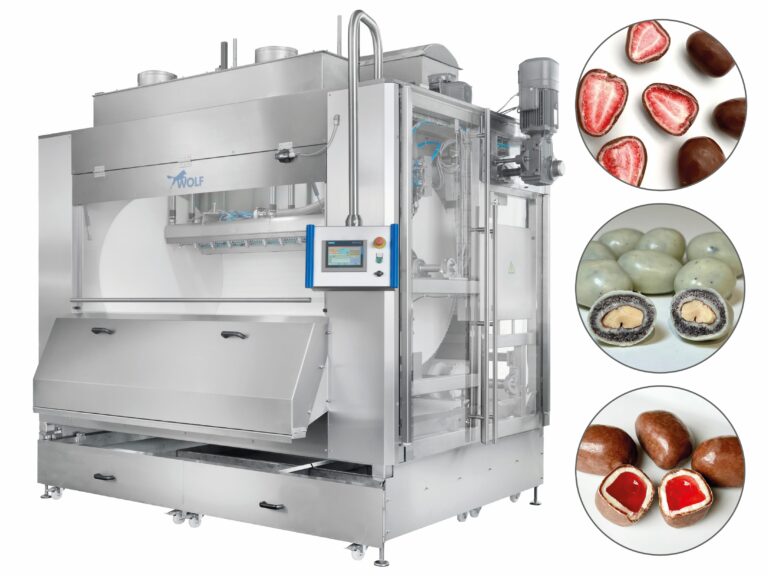
Carefully selected emulsifiers help stabilise fat crystal networks and maintain viscosity stability during dipping. Ammonium phosphates and PGPR improve flow and adhesion, while crystallising agents support rapid, controlled fat solidification.
The result is better coating adhesion, ensuring a more uniform and secure layer around the centre, alongside reduced cracking during cooling, handling and storage. Improved gloss enhances visual appeal at point of sale, while greater resistance to moisture migration helps protect texture and extend shelf life. At the same time, these functional benefits contribute to stable dipping performance, supporting consistent processing conditions and reliable, high-quality output.
This ensures consistent coating behaviour even under demanding production conditions.
In frozen applications, process reliability is as important as formulation performance. By combining emulsifier expertise with crystallisation control, manufacturers can secure consistent visual and structural quality at industrial scale, even in highly challenging environments.