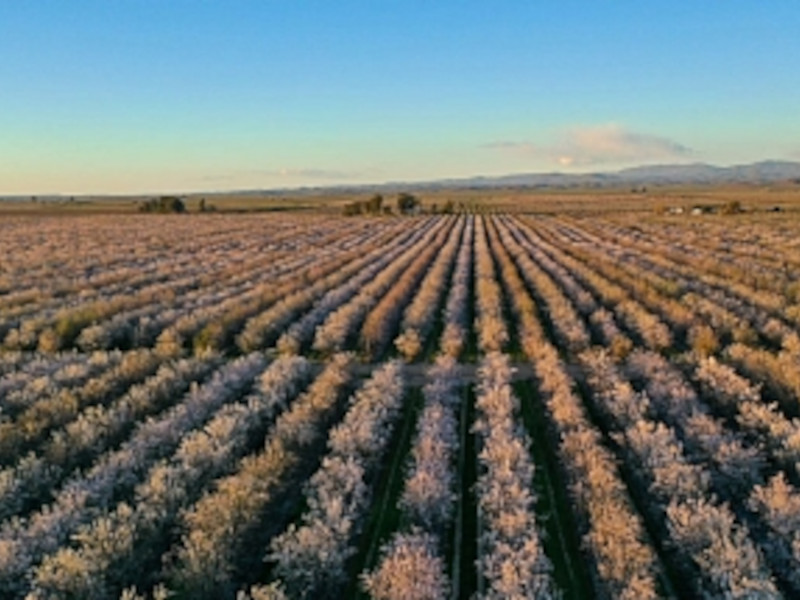

In 2023, KIND took a significant step toward future proofing its hero ingredient, almonds, by launching the KIND Almond Acres Initiative, a three-year regenerative agriculture pilot in partnership with ofi, a global leader in food and beverage ingredients and solutions. This initiative was a key first step in KIND’s commitment to source 100% of its almonds from farms leveraging regenerative agriculture practices on a mass-balance basis by 2030.
Now, at the conclusion of the pilot, KIND is announcing that it has successfully scaled regenerative agriculture practices across its almond supply chain, sourcing approximately 50% of its almond volume from farms leveraging regenerative agriculture practices on a mass-balance basis in 2026. This milestone puts the brand well on track to achieve its 2030 goal.
As one of the nation’s largest almond buyers, sourcing millions of pounds of almonds each year, KIND recognizes the important role it can play in helping advance more sustainable almond production. Through the KIND Almond Acres Initiative, the company tested regenerative agriculture practices and innovative technologies in California, home to approximately 80% of the world’s almond production, to better understand what works on the ground and at scale.
From the outset, the initiative was designed to generate the data and insights needed to identify the most effective combination of practices and technologies for improving soil health, resource efficiency, and on-farm resilience. The results demonstrate that regenerative almond production can deliver measurable environmental benefits while remaining viable at commercial scale. Now, the learnings from the pilot are helping inform KIND’s path forward while contributing valuable insights that can support broader adoption of regenerative agriculture across the industry.
While transitioning to regenerative agriculture requires significant farm management changes and investments, KIND seized the opportunity to scale the KIND Almond Acres Initiative after just one year of testing and learning. In year two, KIND and ofi doubled the initiative to nearly 1,000 acres by expanding from Madera, California, to 500 additional acres in Bakersfield, California, to test how regenerative practices perform across different growing conditions and climates, helping generate insights that can support broader adoption across the almond industry. The initiative functioned as a “living, learning lab” and allowed continuous evaluation to see which practices could deliver the greatest benefits for almond production.
Following three years of data collection through the KIND Almond Acres Initiative, including data provided by ofi’s Carbon Trust certified Digital Footprint Calculator, part of its AtSource sustainable sourcing solution, the pilot’s results demonstrate that combining regenerative agriculture with new technologies can drive critical outcomes. This includes carbon reduction, improved soil health, and greater water and nitrogen use efficiency.