
Protein snacks and functional confectionery continue to grow in importance. Consumers increasingly expect reduced-sugar or sugar-free products, convenient single portions and additional functional ingredients. As an innovative, practical and appealing alternative to traditional protein shakes and snacks, jelly products offer a new format, but present manufacturers and equipment suppliers with particular challenges.
Aligning recipe and process
When producing protein-enriched gummy products, the protein content is not the only decisive factor. A successful recipe must combine pleasant sensory properties, a stable gel structure and a sufficiently high protein or collagen concentration. It must also be suitable for safe and reproducible industrial processing.
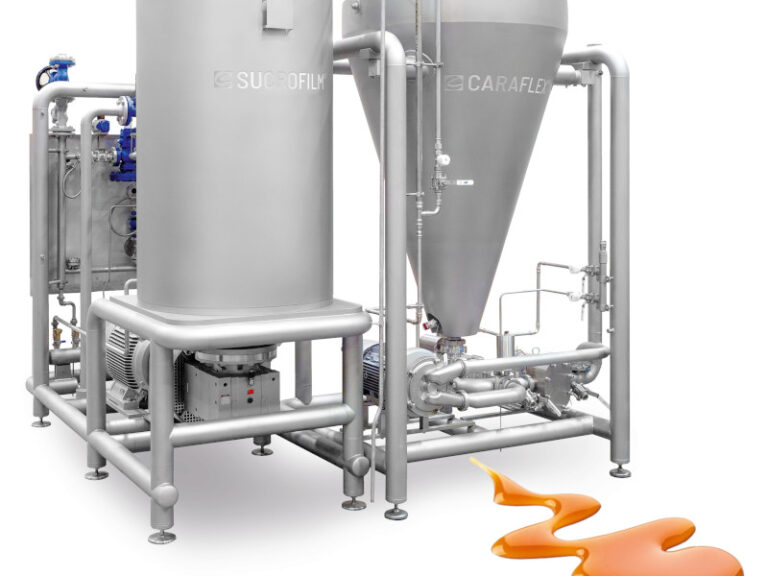
This requires the raw materials, temperature profile, mixing process and dosing technology to be precisely coordinated. Temperature control is particularly important when whey protein is used: excessive thermal stress can cause the protein to denature and flocculate. Targeted temperature management is therefore essential to ensure stable processing and the desired product quality.
The choice of production process also influences recipe development. When producing protein gummies using the starchless process, which is preferable for the manufacture of functional confectionery, the addition of gelatin is required to enable the products to be demoulded promptly.
Differences between the starchless and Mogul processes
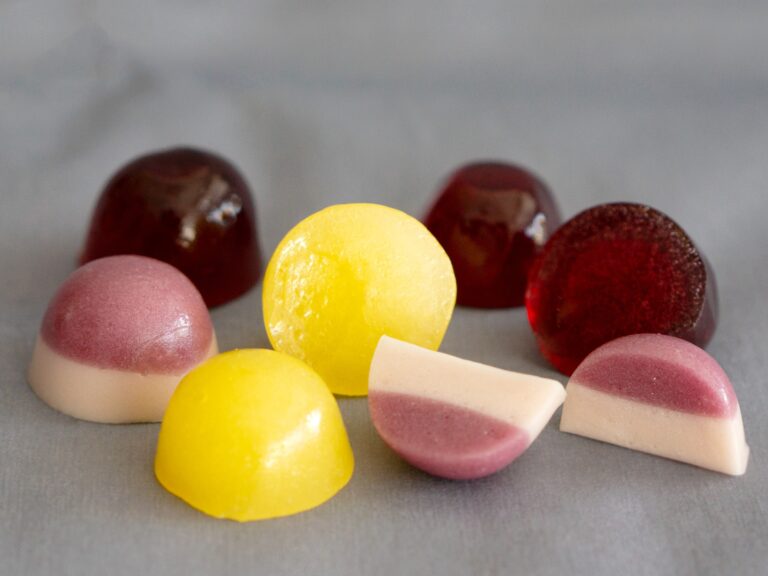
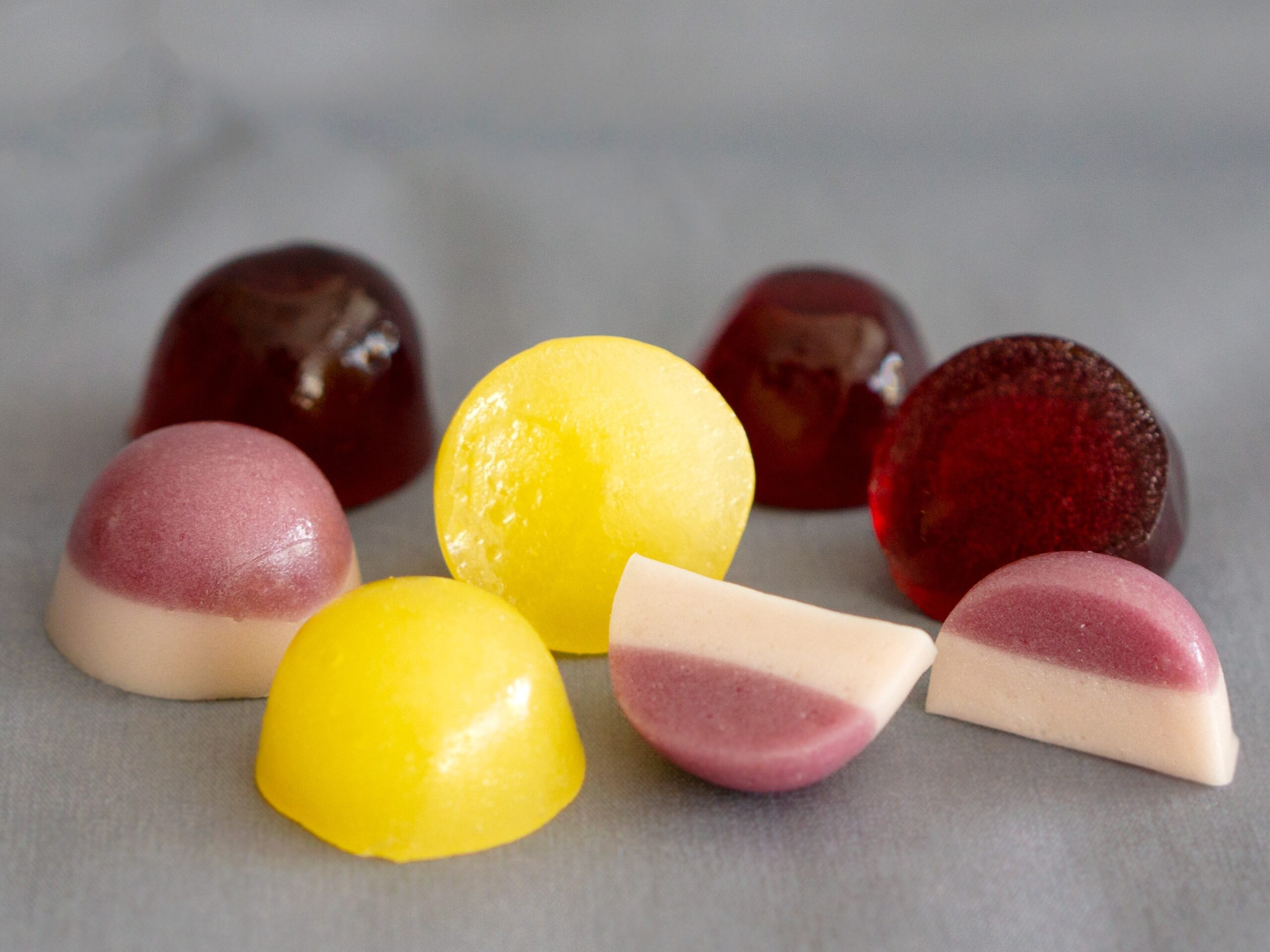
In-house trials were used to develop both a collagen gummy and a high-protein gummy based on gelatin. For sugar-free formulations, total protein contents of around 15 to 20 g per 100 g of finished product were achieved using the starchless process. In the Mogul process, significantly higher contents of up to 40 g total protein per 100 g of finished product were possible. The key advantage of the Mogul process is that depositing masses with higher water contents can be processed. This preserves the required depositability even at higher protein concentrations. The moisture is then specifically reduced during the drying process.
From a process-engineering perspective, the Mogul process therefore offers greater tolerance for high-protein formulations. The starchless process, by contrast, is characterised by a compact process flow and is particularly suitable for functional products where rapid demoulding and special hygiene requirements are the priorities.
Technological challenges
Protein-rich gummy masses often have higher viscosities than conventional masses. At the same time, proteins and collagen affect the gel structure, mouthfeel and processability. The key technological challenges therefore include:
- processing higher viscosities,
- influence of protein and collagen on gel formation,
- precise control of the product temperature,
- adjusting the mixing and dosing processes, and
- maintaining suitable residence times.
Developing a market-ready product therefore requires a holistic approach. The decisive factor is the coordinated interplay of recipe, process and equipment technology.
From laboratory recipe to industrial production
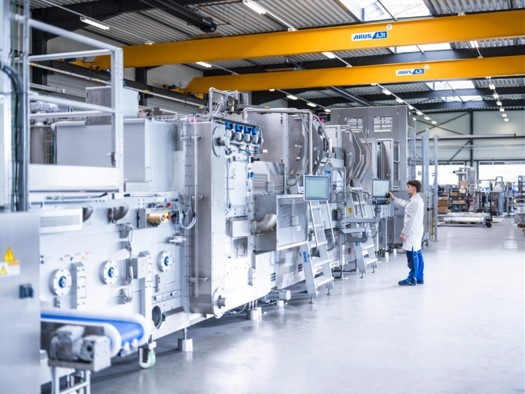
WDS supports customers from the development phase onwards and accompanies them on the journey from laboratory recipe to industrial production. This includes:
- selecting and evaluating suitable raw materials,
- developing and adapting the base recipe,
- trials in the WDS Product Innovation Centre using pilot plants,
- optimising temperature profiles and residence times,
- coordinating the dosing process,
- evaluating texture and processability,
- transferring the process to the production line,
- as well as customer support and training.
By combining recipe development, process expertise and equipment technology, WDS creates the conditions required to transfer even demanding high-protein and collagen products safely and reproducibly into industrial production.