
A technical primer on colours

Technical Editor Clay Gordon provides a brief but thorough overview of how the coating of confectionery impacts the flavour….

Share this article:

Technical Editor Clay Gordon provides a brief but thorough overview of how the coating of confectionery impacts the flavour.

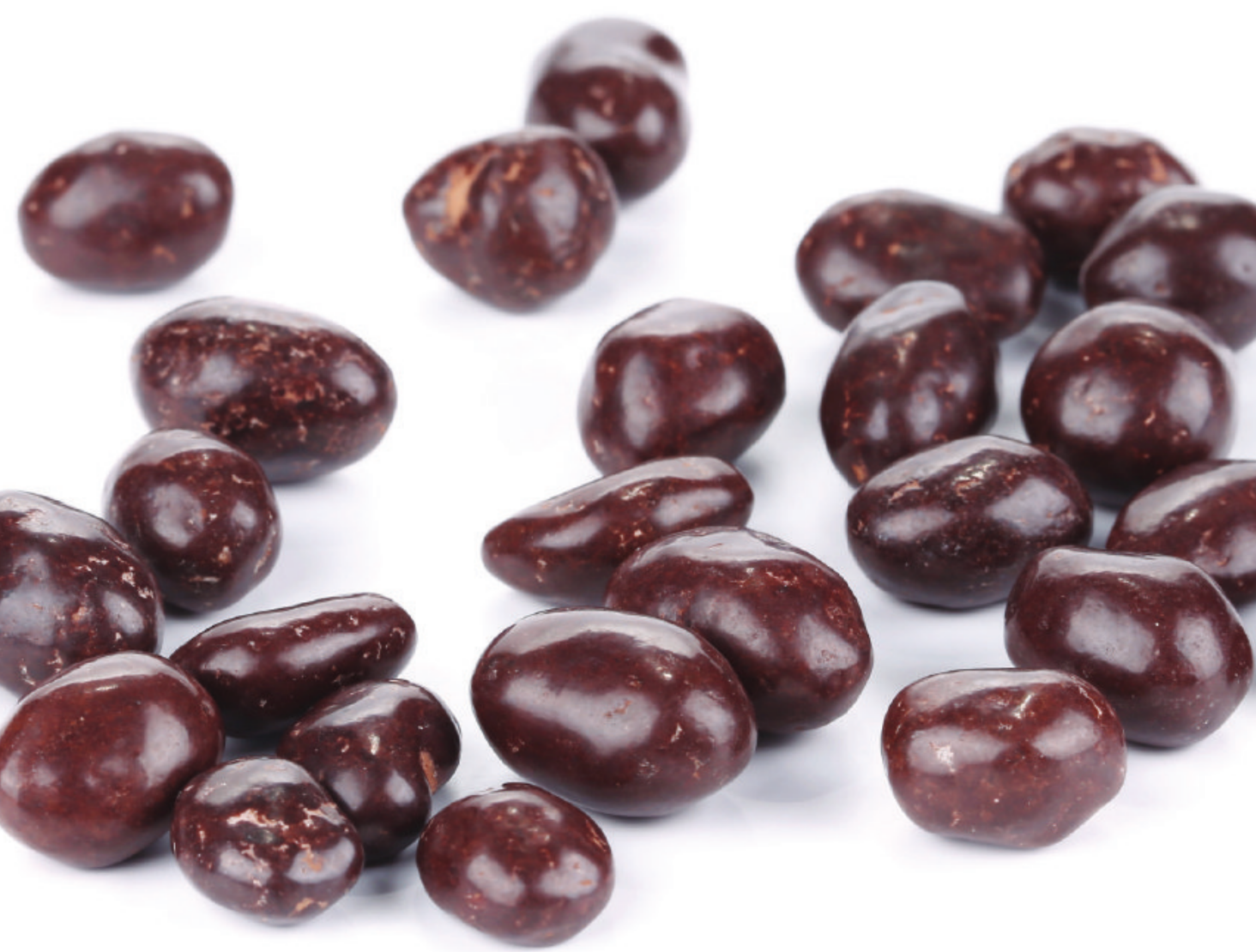
Panned items make up a large portion of the chocolate and sugar confectionery market, and for good reason: it’s an extremely versatile technique that enables the production of a wide range of products – from sugar candy-coated chocolate lentils to chocolate-covered nuts, and more. 

And while the technique itself is easy to explain, like most things, being able to produce high quality product consistently – at any scale – requires skill and practice. The same is true for the entire range of cocoa butter-based airbrush, spatter, and other surface decoration techniques used in chocolate bonbon production 

Behind these seemingly simple ideas lies a complex set of interdependencies as the finished panned product is built up, layer by layer, from the centre out and the bonbon is built up layer by layer from the outside in. 

I’ve covered some of these layers in previous issues of International Confectionery. In the October 2021 issue I took a look at one of the questions I get asked most when it comes to panning, which is about vegan options for coating, polishing and glazing. For the May 2022 issue I explored colourings and flavourings that can be used in sugar or chocolate work. 

For this issue the focus is on gaining a better understanding of some nuances in the vocabulary of colour as it is used in food production. This understanding will be helpful when visiting a vendor’s website where you will encounter a wide range of terms you may be familiar with.  

Familiar, at least, in the sense that you’ve seen the words before – perhaps on an ingredient label – but you may never have stopped to think what they actually imply and mean. For example, what is a “lake” pigment and how does it differ from a “great” lake? What does “natural” mean in when it comes to food colours? From a food safety perspective, what is the difference between being non-toxic and edible? What does FD&C mean? What are the implications – if any – for pigments that may be suitable for use in the US but not in Europe? Finally, what the heck is up when it comes to the status of titanium dioxide (TiO2)? 

A dye is a colouring agent – a pigment – that is water-soluble, completely dissolving, thereby changing the colour of the water. 

An FD&C “lake” colouring is made by chemically binding a water-soluble dye to a particle of a metal salt. This process is known as “laking” and is derived from the word lac. The end result is a coloured particle that is no longer water soluble; laked particles are dispersed (suspended) in water. A “great lake” is the fat-based version of a lake – the pigment is chemically bound to a small carrier particle that can be suspended in a fat or oil...

To read more see our latest issue here.

Media contact

Caitlin Gittins
Editor, International Confectionery
Tel: +44 (0) 1622 823 920
Email: [email protected]

About International Confectionery

International Confectionery is the leading authority in global confectionery content, delivering expert news, in-depth articles, exclusive interviews, and industry insights across print, digital, and event platforms. Published 10 times a year, the magazine is a trusted resource for professionals seeking updates and analysis on the latest developments in the confectionery sector.

To submit an article, or for sponsorship opportunities, please contact our team below.

Joseph Clarke Picture

Joseph Clarke

Senior Editor

Steve Blakebrough Picture

Steve Blakebrough

Sales Manager

Afua Akoto Picture

Afua Akoto

Marketing Manager

Related News

Nexture Sustainability

Nexture Publishes First Sustainability Report

Nexture has published its first Group Sustainability Report, establishing a shared framework for reducing environmental impacts, improving responsible sourcing and developing more sustainable ingredient solutions.
ipco pack expo

IPCO Unveils Chocolate Forming Solutions

IPCO, a supplier of chocolate forming and moulding equipment, showcased its latest innovations at PACK EXPO 2026, emphasizing advancements in chocolate chip production and cooling systems.
Domori

Domori Launches in the UK

Italian chocolate producer Domori has introduced its professional couverture chocolate range to the UK, targeting chocolatiers, pastry chefs, gelato makers and other specialist dessert producers.
KitKat Nestle

KitKat Drives Formula 1 Excitement

Nestlé International Travel Retail (NITR) has brought the excitement of the KitKat and Formula 1® partnership to travellers at Singapore Changi Airport through a high-impact activation combining immersive brand experiences, personalisation and travel retail-exclusive products.
EXBERRY colour selection

GNT Secures ISO Carbon Verification

GNT has become one of the first food colour manufacturers worldwide to have its Product Carbon Footprint (PCF) methodology independently verified in line with the ISO standard.
NSD

Celebrating US National Real Sugar Day

The Sugar Association will celebrate National Real Sugar Day on October 15 by recognising real sugar’s role as a real, recognisable ingredient in real food. This year’s celebration also highlights that real sugar is rooted in nature and is at the heart of real recipes and scratch cooking.
Anuga India

SACMI highlights integrated chocolate processing

SACMI Packaging & Chocolate is showcasing its latest chocolate processing and packaging technologies at Anuga FoodTec India 2026, highlighting an integrated portfolio spanning production, wrapping, handling and secondary packaging.
Anuga India

Anuga FoodTec India is Open

Anuga FoodTec India 2026 has opened its doors in Mumbai, bringing together food and beverage technology suppliers from around the world for three days of processing, packaging and manufacturing innovation.
Chocolate

Nestlé appoints Group General Counsel

Nestlé’s Board of Directors has appointed Manuela Bernasconi, currently General Counsel for Zone Americas, as Group General Counsel and a member of the Group Executive Board, effective 1 January 2027. After seven years as Nestlé’s Group General Counsel, Leanne Geale will retire.
Scroll to Top